
Linguistic Thought and the Worlds Around It
David Karlander, Senior Fellow.
David Karlander is a linguist whose research explores the relationship between systems of linguistic thought and the connections between academic and lay languages. During his stay as Senior Fellow at TRANSITION, he brings this broad interest in ideas about language and their connections to culture, society, and politics into conversation with the center’s research on change of language through rural-urban transitions.
David is Assistant Professor of Scandinavian Languages at Uppsala University and a Pro Futura Scientia Fellow at the Swedish Collegium for Advanced Study. Across his research, he has approached linguistic thought from different directions, including the linguistics and politics of Övdalsk, the influence of Nazi linguistics on contemporary theories of linguistic deficit, the history of language policy and planning, and the art and politics of constructed languages.
For David, these subjects are connected by a broader concern with the place of linguistic ideas in society. “My work says something about how and why seemingly marginal linguistic ideas can have quite a strong influence on culture and politics,” he explains.
Linguistic thought is intrinsically connected to society at large, and scholars and stakeholders need to figure out what these connections mean and do.
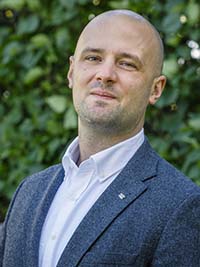
David received his doctorate from Stockholm University in 2017 and has worked at Uppsala Univerity since 2023. His academic life has taken him through a number of different places. Beginning in Sweden, linguistics later brought him to Himachal Pradesh as an undergraduate student, Cape Town as a visiting doctoral student, Hong Kong as a postdoctoral fellow, and Freiburg im Breisgau as a Marie Skłodowska-Curie fellow before now spending time in Copenhagen as a Senior Fellow.
Across these different places, David emphasizes the people and intellectual environments he has met along the way: “I am fortunate to have worked with some tremendously generous people, some of whom have become lifelong friends.” At TRANSITION, David will be working on his ongoing project on constructed languages as well as critically revisit early-20th century theories of urban vernacular language.