
“Inside. From the Bottom of the Pyramid”: A Cosmopolitan Outlook in Danish
Esben Juhl Morthorst, Student Fellow
Esben Juhl Morthorst is a BA student in Danish at the University of Copenhagen. In his thesis, he examines how experiences of place, belonging and urban life are expressed through language and artistic practice. Focusing on the artists Halfdan Pisket and Hari Shankar Kishore, he brings together perspectives from literary studies, sociolinguistics, and media studies to investigate how their work relates to social change in an increasingly urbanised and globalised society.
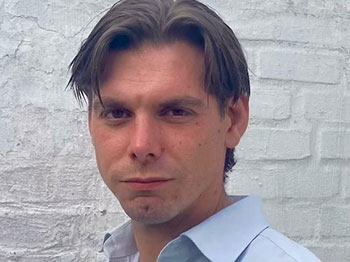
Esben is particularly interested in artists whose work crosses conventional boundaries between different media and artistic forms. Both Pisket and Kishore are also involved in activism, making their work a starting point for examining political and linguistic conflicts in Denmark in the years following the turn of the millennium.
His is driven by a broader interest in how people experience and negotiate the places to which they belong: “I want to explore how territories and places are negotiated through language, cultural practices, and forms of expression.” By examining the artists’ work from different disciplinary perspectives, he hopes to get insights into how ideas about place, belonging, and urban experience are articulated both linguistically and aesthetically.
Esben’s interest in these questions has personal roots. He grew up in a traditional timber-framed house with a thatched roof in a village on Copenhagen’s western outskirts, surrounded by contrasting environments. Horse paddocks, forests and a public swimming pool lay on one side, while social housing developments lay on the other. At school and through everyday encounters, he met children from a wide range of social backgrounds.
I want to explore how territories and places are negotiated through language, cultural practices, and forms of expression.
These experiences gave him an early awareness of social diversity, but also of the different meanings attached to places. “I learned early on that places are never neutral,” he recalls. His village, with its medieval church and local traditions, existed alongside post-war urban development. Yet its identity was not straightforward: “We were not authentic Vestegn residents. We were not Copenhageners. We occupied an in-between position.”
At TRANSITION, Esben hopes to develop his interdisciplinary approach through a dialogue with researchers working across language, literature and history. He is particularly interested in learning how interdisciplinary research works in practice and in developing his theoretical and methodological approach as part of that.