
Historical data: The National Museum’s Ethnological Surveys and The Workers Recollections Archive
Our research places people at the heart of what we explore. Taking a human-centered approach, we study how individuals experience the change from rural to urban-centric societies and how their lives intersect with these historical changes.
Our historical data includes the National Museum’s Ethnological Surveys (NEU) and the Workers Recollections Archive (NIHA), both collected and part of the Modern History Archive at the National Museum of Denmark. This data allows us to study how people lived, worked, and related to one another across time and space.
The collections contain very detailed aspects of everyday life, aspects that are often overlooked in other contexts. And in that sense, there is nothing the archives won’t be able to tell you something about. Rather, the challenge is finding it in the large amount of data we have.
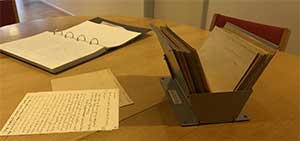 The surveys were initiated in 1939. Their purpose was to document the practices and ways of living of Denmark’s pre-industrial rural population. For that purpose, the surveys cover topics close to people’s everyday lives based on their memories of what their life was like from around the turn of the century. While keeping its focus on everyday life in Denmark, NEU later expanded its scope to also include other groups than only Denmark’s rural population. The most recent survey is from 2021 exploring life during the COVID-pandemic. NEU includes survey responses and material such as diaries, official service record books (skudsmålsbøger), and various other personal accounts documenting everyday life.
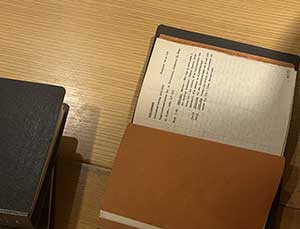 NIHA contains accounts from surveys conducted between 1952 and 1959, documenting the experiences of both skilled and unskilled workers from the 1880s to the late 1950s. The archive was established with the intention of collecting knowledge and data about workers. However, many of the informants wrote about much more than their work. They also shared stories about their families, living conditions, views on and reflections about politics and much more.
Together, NEU and NIHA hold over 50,000 personal accounts, providing a rich source of empirical material for our research. These microhistorical accounts add a human face to broader historical processes, showing that the past was full of individuals whose lives reflect the big historical changes of the so-called long 20th century (1870-present).
It’s very important to have these large collections made up of the accounts of thousands of ordinary people who have written about their own lives and experiences in their own words and voices.