
Graffiti as Critical Practice
Silas Belli, Student Fellow.
What happens when writing on walls is approached as communication rather than vandalism? This question drives Silas Belli’s thesis project in which he explores graffiti as a critical artistic and political practice.
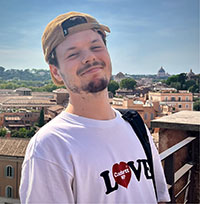 Silas studies Danish at the University of Copenhagen, with a focus on cultural expressions that challenge dominant norms. His project centers on the Danish graffiti writer Spyo, analyzing works across Copenhagen to understand how meaning is shaped not only by content, but by form – through location, illegality, risk, and intention. “There is something compelling about graffiti as an expression without clear personal gain,” he explains. “People take significant risks to create something that many do not understand or even reject.”
Drawing on critical and media theory, Silas examines how graffiti operates as a medium in its own right. In his thesis he asks what kinds of meanings emerge when expression takes place outside institutional frameworks, and how such expressions are positioned within broader cultural and political contexts. Rather than reducing graffiti to a question of “art or vandalism”, he approaches it as a complex visual language embedded in the urban environment:
There is a tension in how graffiti is perceived. It can be celebrated in some contexts and penalized in others. Understanding that tension is key to understanding what graffiti does as a form of expression.
A formative place for Silas was the legal graffiti yard in his hometown of Roskilde – a space where people met to paint, exchange ideas, and experiment with expression across backgrounds and generations. Experiences like these continue to shape his interest in how cultural practices emerge in specific places and communities.
Through his fellowship at TRANSITION, Silas is developing his academic approach in dialogue with researchers across disciplines, refining a project that speaks to the broader question of how forms of expression, which emerge in everyday urban life, challenge how we understand culture, communication, and critique.